Key Takeaways
- Peterson Roofing was founded in 1987 and grew through community trust and persistence.
- The company is built on strong values, especially the Golden Rule and standing behind their work.
- Long-term customer relationships are prioritized over short-term profits.
- Modern systems have been integrated while preserving traditional values.
- Listening to homeowners and providing honest recommendations are central to their success.
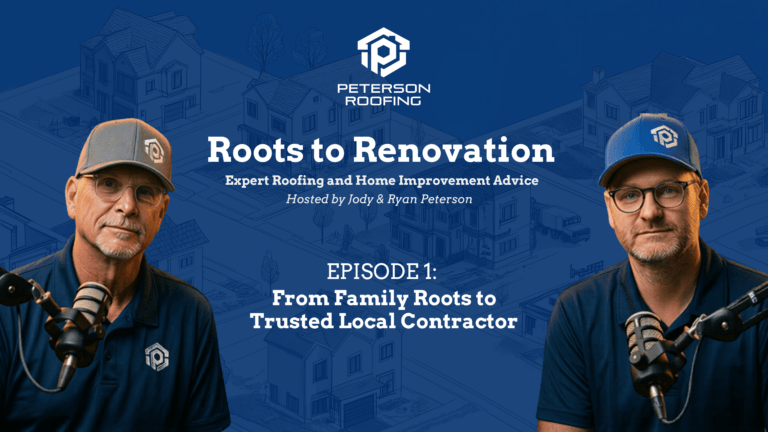
In a recent episode of Roots to Renovation, host Mike Downer sat down with Jody Peterson, founder and CEO of Peterson Roofing, and his son Ryan Peterson, COO. Together, they shared the story behind one of the Quad Cities’ most trusted roofing companies—highlighting decades of hard work, family values, and a commitment to doing right by their customers. For homeowners wondering how to choose a roofing company, their journey offers valuable insight.
A Humble Beginning
Peterson Roofing’s journey began in 1987, when Jody Peterson got his start in construction as a teenager working on roofing crews. What began as a small, struggling company eventually grew through persistence, community relationships, and a willingness to help neighbors—especially following local hailstorms.
Jody’s early approach was simple: help the people around him. By focusing on nearby homeowners and building trust within his own neighborhood, he laid the foundation for long-term success.
Built on Values That Last
At the heart of Peterson Roofing is a timeless principle: the Golden Rule. Jody emphasizes treating customers with honesty, respect, and care—values that continue to guide the company today.
One of their defining commitments is standing behind their work. Unlike companies that disappear after completing a job, Peterson Roofing prioritizes long-term relationships and ongoing support for customers—even years after a project is finished.
Growing a Family Business
Ryan Peterson’s journey into the business started early—literally climbing ladders on job sites as a child. Although he initially pursued a different path through business school, he eventually returned to help grow the family company.
Ryan brought modern systems into the business, transitioning from paper-based processes to digital tools for estimates, materials, and customer management. Despite these updates, the company has remained firmly rooted in its original values.
Earning Trust in the Community
Over the years, Peterson Roofing has built strong relationships with homeowners, builders, and even local building inspectors. Their reputation is reinforced by word-of-mouth referrals in a close-knit community where trust is everything.
Small gestures—like fixing minor issues at no charge—have made a big impact. These acts of service demonstrate a commitment to people over profit and help foster lasting relationships.
What Homeowners Really Need
After completing more than 200 jobs annually, Peterson Roofing has learned that the key to customer satisfaction is simple: listen.
Rather than relying solely on technology or quick estimates, the team prioritizes understanding each homeowner’s unique concerns. This approach allows them to identify underlying issues—such as ventilation problems—and provide thoughtful, long-term solutions.
Honesty Over Profit
One of the most compelling aspects of Peterson Roofing’s story is their dedication to honesty. Whether it’s recommending a repair instead of a full replacement or completing small fixes at no cost, the company consistently chooses integrity over short-term gain.
This philosophy not only builds trust but also sets them apart in an industry where upselling can be common.
A Legacy That Endures
Today, Peterson Roofing stands as a testament to what can be achieved through hard work, integrity, and community focus. As a father-and-son team, Jody and Ryan continue to uphold the values that have guided the company for over four decades.
Their message is clear: they’re here to stay, and they’re committed to taking care of their customers for years to come. If you’re thinking about how to choose a roofing company, their story shows that experience, honesty, and long-term commitment matter most.
FAQs
1. What makes Peterson Roofing different from other roofing companies?
Their commitment to honesty, long-term customer relationships, and standing behind their work sets them apart.
2. How long has Peterson Roofing been in business?
They have been serving the Quad Cities for over 45 years, with the company formally established in 1987.
3. Do they only focus on large roofing projects?
No, they handle both large and small jobs, and even assist with minor fixes—sometimes at no charge.
4. How has the business evolved over time?
The company has transitioned from paper-based systems to modern digital tools while maintaining its core values.
5. What is their approach to customer service?
They prioritize listening to homeowners, understanding their needs, and providing honest, practical solutions.
Mike: Hey, everybody. I am Mike Downer, your host. Today I’m sitting here with Ryan. He is the owner of Right Roofing. So welcome, Ryan, and thanks for taking the time out of your day to talk to me for a little bit here.
Ryan: Hey, Mike. Happy to be here.
Mike: Awesome. So, Ryan, tell us a little bit about Right Roofing. Tell us about yourself—why you got into it, how long you’ve been doing it. Just give us a little background.
Ryan: I’ve been doing this for almost twenty-nine years. I started out basically just as something to do. I was a young kid and had done all sorts of different things. I grew up in a small town in Northern Iowa doing all the things a Midwest kid did back then—lots of mowing lawns, snow removal, just basic stuff trying to make a living.
So I’m in my early twenties and I had an opportunity. I actually had a cousin here in the Des Moines area that was roofing kind of part-time. He was a really good craftsman. I basically thought, “Oh, I can make decent money doing this,” and decided to learn the trade. I think I was probably twenty-two or twenty-three years old.
For the first four to five years, I just did the work. I had to figure out how the systems worked, how they went together, and all the nitty-gritty hard labor that roofing actually is. I had to do every level of it and every part of it.
Mike: You probably carried a couple of bundles up on your shoulder, huh?
Ryan: A lot of that—plus nasty cleanup work for multiple-layer tear-offs. One of the biggest things we learned early on was to do a good job and keep everything tidy and clean. That was a big part of it—being able to clean up really well.
Mike: That’s huge for homeowners. So twenty-nine years of experience—that’s quite a long time. Why does your experience matter to a homeowner? How is that important?
Ryan: For a homeowner, having access to our level of knowledge in the roofing industry is pretty much unparalleled—especially with all the companies out there now that are basically marketing companies. They’ve never done the trade and don’t fully understand it.
What that allows for us is that we care about our installers because we understand how hard the work is. Our guys are happy doing it. They know they’re going to make enough because the person estimating—me for a lot of years—understood the actual work and what needed to be done.
So when a customer calls us and they’re having a problem nobody else can figure out, we’re pretty much the last call because we’re going to help them figure it out. A lot of companies do roofing, but the problems usually come from how it ties into other systems. Early on, everyone would point fingers: “The roofing system is fine—it’s not our issue.”
When that didn’t solve the problem, most guys would just pull out a caulking gun and hope it worked. We actually dig into it. We’ll tear apart siding around the roof to make sure everything integrates properly. Everything has to work together.
Mike: Sounds like you’ve had hands-on experience at every level—from pounding nails to hauling shingles. How did that shape your standards to run your company?
Ryan: We know what’s important and what’s not. There are things we simply won’t cut corners on. Some customers aren’t willing to do that, and not everyone can be our customer. We can’t fix problems without taking extra steps, because we have a base level of standards that must be hit on every project to make sure it won’t be a problem later.
Mike: That’s awesome. What early lessons did you learn—things you do differently now?
Ryan: I’ve probably forgotten a lot—that’s a loaded question over almost thirty years. But early on, we knew the roofing system, then tough problems came up—like leaks that only happened occasionally. We weren’t going to leave customers hanging.
We had a townhome owner with a leak. I checked all the flashing and did the normal work. Then I started looking at surrounding systems. It turned out to be a vinyl siding issue—the house wrap wasn’t installed properly, and it wasn’t integrating with the roofing system. It was a simple fix, but we had to be willing to take that extra step. That was a big learning moment.
Mike: With your company, you do new construction as well as tear-off and replacement. What are the differences, and why are the details so important?
Ryan: New construction is a new build. We show up to a muddy development, get materials on the roof, and roof and flash everything properly. The problem is everyone’s there to do their one thing. When there’s an overlap, people point fingers.
That’s why we decided to take on siding after years of roofing. We didn’t want to point fingers—we wanted to solve the issues. Then we realized that when doing siding, it’s efficient to replace windows. That’s when we added windows, because now we’re dealing with the entire exterior envelope of the house. That envelope has to work together properly.
Mike: So you’ve got homeowners covered from top to bottom. Expand on why it’s important to do windows and siding together.
Ryan: The biggest reason is it saves money. If you replace windows alone, installers have to tie into existing siding and flash everything. Many companies use replacement windows because it’s cheaper and avoids siding work—but that doesn’t necessarily solve insulation or air-seal issues.
If you coordinate windows with siding, you save labor by not pulling things apart twice. There’s often about a fifty percent labor savings when you coordinate the project.
Mike: And doing it wrong can lead to leaks, rot, and bigger problems later.
Ryan: Exactly. Otherwise, companies just point fingers—“It’s not the window, it’s the siding.”
Mike: It’s similar to putting new gutters on an old roof.
Ryan: Right. If your roof is eighteen to twenty years old and you put on new gutters, when you replace the roof later we have to remove and reflash everything. You end up paying twice.
Mike: Let’s lighten the mood. Tell us one of your most memorable roofing stories.
Ryan: One of the most memorable wasn’t really roofing—it was siding. About twenty years ago, a customer in Glen Oaks had a full brick house and constant tuck-pointing issues. He wanted to tear off all the brick. I thought he was nuts.
We removed about sixty square of brick—twice the size of a normal house. As we tore it off with hammers and chisels, we discovered massive rot underneath. There was no house wrap. Brick and mortar actually wick moisture. His house had been leaking since it was built.
We ended up reframing a three-story chimney and fixing extensive rot. The fix at construction would have been simple—proper house wrap and flashing.
Mike: How long were you on that job?
Ryan: About a month—with lots of guys, brick, and dumpsters. But we solved the problems.
Mike: And that could have been avoided cheaply.
Ryan: At the time, about three hundred dollars in materials and similar labor would have saved him six figures. It was probably a fifteen-year-old house.
Mike: That’s a painful lesson.
Ryan: Definitely.
Mike: We learned a lot about your company. We’ll keep these sessions going and dig deeper into roofing, siding, windows, and technical aspects homeowners should know. I appreciate your knowledge. We’ll talk again soon.
Ryan: Sounds great.
Mike: All right. Thanks, Ryan.
Ryan: Thanks, Mike. Bye-bye.