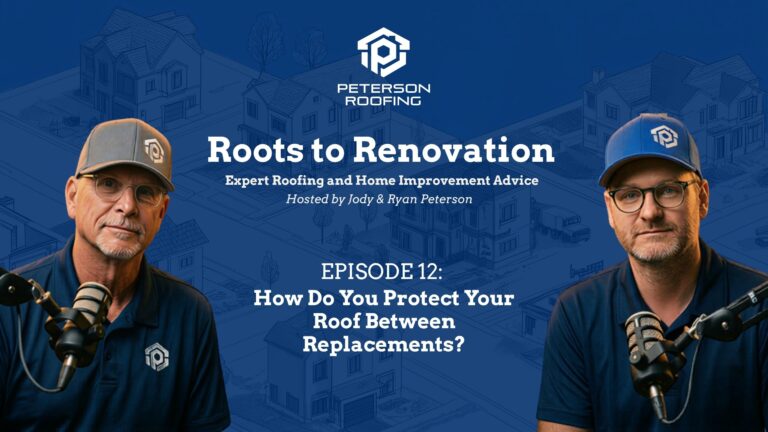
To maintain your roof in Davenport, Iowa, check it from the ground every spring and fall and after major storms, clean the gutters at least twice a year, keep tree branches about ten feet back, watch the attic for moisture and book a professional inspection once a year.
A roof can look perfectly fine from the ground while small problems quietly develop underneath. On Episode 12 of Roots to Renovation, host Mike Downer talks with Peterson Roofing founder and CEO Jody Peterson and his son Ryan Peterson about how to maintain your roof Davenport Iowa homeowners can follow between replacements. Catching a minor issue early can prevent leaks, structural damage and expensive interior repairs later.
Peterson Roofing and Home Improvement is a family-owned roofing contractor in Davenport, Iowa, that serves the Quad Cities, including Bettendorf, Moline and Rock Island, and it also handles siding, gutters and other exterior work.
Why Are Spring and Fall Roof Inspections Important?
Spring and fall are two of the best times to check a roof because they allow homeowners to identify problems before extreme summer or winter weather makes repairs more difficult.
Ryan explains that damage may come from storms, animals or ordinary wear that homeowners simply cannot see from the ground. A small leak can continue unnoticed until moisture reaches the roof decking, insulation or interior ceilings.
The National Roofing Contractors Association also recommends checking roofs in spring and fall for problems such as cracked or missing shingles, deteriorated flashing and excessive granules in gutters.
Rather than climbing onto the roof yourself, homeowners can perform a visual check from a safe location and have a roofing professional inspect areas that are difficult to evaluate.
How Do Gutters and Trees Affect Your Roof?
Clogged gutters and overhanging branches both send water and wear toward the roof, which is why Jody recommends cleaning gutters at least twice a year, ideally during spring and fall. Clogged gutters can cause water to overflow or move back toward the house. In some cases, that moisture can damage soffits and eventually find its way into interior walls or ceilings.
Keeping gutters clear is also part of broader moisture control. The U.S. Environmental Protection Agency recommends regularly cleaning and repairing roof gutters to help prevent moisture problems inside the home.
Nearby trees deserve similar attention. Jody and Ryan suggest keeping branches that could rub against the roof about 10 feet away when practical. Strong winds can move limbs much farther than homeowners expect.
That concern is especially important after severe weather. Iowa State University Extension and Outreach notes that wind, ice and snow can damage tree limbs and recommends inspecting storm-damaged trees for broken or weakened branches that could threaten nearby property.
Why Does Attic Ventilation Matter?
Attic ventilation matters because moisture trapped under the roof decking can weaken or rot the wood from below and shorten the life of the whole roof system. Roof maintenance is not limited to what happens outside.
Jody says poor ventilation can allow moisture to accumulate underneath the roof decking. Over time, wood may weaken or rot. Homeowners may eventually notice dips in the roof or soft areas in the decking.
Proper ventilation helps manage this moisture. According to the National Roofing Contractors Association, attic ventilation is particularly valuable in cold climates because it can help remove excess moisture and reduce condensation that may damage roof sheathing.
The goal is not simply replacing damaged wood. The underlying ventilation or moisture problem must also be corrected so the damage does not return.
What Should You Check After a Major Storm?
After hail, high winds or a severe thunderstorm, walk around the property and look for obvious changes.
Ryan recommends watching for missing shingles, fallen branches, damaged siding, loose fascia and other visible storm damage. Jody adds that an unusual amount of roofing granules appearing near downspouts can also indicate that the roof experienced significant wear or storm impact. Ryan adds that siding and fascia metal cannot stand up to high wind as well as modern shingles, so walk the whole exterior, not only the roofline.
Not every problem is visible from the yard. Flashing around roof penetrations, chimneys and other transitions can loosen without creating an obvious gap that homeowners notice.
That is one reason an annual professional inspection can be worthwhile. As Jody explains, roofing professionals are trained to recognize flashing problems and other subtle issues that may otherwise go unnoticed. Our summary of what happens during a professional roof inspection explains what that visit covers.
Why Can Small Roof Repairs Save Money?
Routine maintenance is usually easier to deal with than the damage created by a long-running leak.
Mike shares his own experience with an aging roof that eventually leaked into a vaulted bedroom ceiling. Fixing the problem required more than roofing work. Damaged wood, drywall, ceiling texture and paint also had to be addressed.
Ryan summarizes the lesson simply: “Spend a little in the beginning and save a lot later on.”
Water is particularly important to address quickly. The EPA’s guidance on moisture and mold recommends fixing water problems promptly and drying wet materials quickly to reduce the chance of mold growth.
Watch the Full Roots to Renovation Conversation
Want more practical advice on how to maintain your roof Davenport Iowa homeowners can use year-round? Watch the full Roots to Renovation conversation on YouTube. Mike, Jody and Ryan discuss inspections, gutters, trees, ventilation, algae and storm damage while explaining how routine maintenance can protect your home and prevent costly repairs.
FAQs
How do you maintain your roof in Davenport, Iowa?
Check the roof from the ground every spring and fall and after major storms, clean the gutters at least twice a year, keep branches about ten feet away, watch the attic for moisture and have a professional inspect the roof once a year.
How often should homeowners inspect their roof?
Check the roof visually in spring and fall and after major storms. A professional inspection once a year can help identify problems that are difficult to see from the ground.
How often should gutters be cleaned?
Jody recommends cleaning gutters at least twice a year, particularly in spring and fall. Homes surrounded by trees may need more frequent cleaning.
How far should tree branches be from a roof?
The Peterson Roofing team suggests roughly 10 feet of clearance for branches that could move and rub against the roof during high winds.
What are signs of poor attic ventilation?
Moisture beneath the decking, weakened wood, visible roof dips and excessive attic humidity can indicate ventilation or moisture problems.
What should I look for after a hailstorm?
Check for damaged siding, fallen branches, missing roofing materials and unusually large amounts of shingle granules around gutters or downspouts.
Can clogged gutters damage a roof?
Yes. Blocked gutters can cause water to overflow or back up toward soffits and other parts of the home, potentially leading to moisture damage.
Should homeowners climb onto their own roofs?
Generally, no. Roof work carries a serious fall risk, and professionals are trained to inspect roofing systems safely while identifying damage that homeowners may overlook.
Mike: Hello, everybody. Welcome to Roots to Renovation. I am your host, Mike Downer, and I am here with the gentlemen from Peterson Roofing. I’ve got Jody Peterson, the founder and CEO, and his son, Ryan, who is not wearing a hat today. Look at Ryan over there. You’re looking good, buddy.
Ryan: Thanks, man. How are you doing, Mike?
Mike: I’m doing great. It’s always good to talk to you guys. You’re always fun to talk to, and I always have a great time talking with you.
Jody Peterson: It’s good talking to you too, Mike.
Mike: Today, gentlemen, if it’s okay with you, we’re going to talk about how homeowners can protect a roof between replacements. We’ll cover what homeowners should do on a regular basis to maintain their roof, extend its lifespan, and avoid premature failure. So, guys, what should homeowners check during spring and fall roof inspections in Iowa?
Ryan: Sure, I’ll go ahead and start. It’s very important to take a look because a lot of people just don’t think about their roofs. Here in the Quad Cities, we’ve seen thousands of homeowners get the most out of their roofs, and we’ve got some tips that can help homeowners do that and make a difference in how much life they get out of their roof.
I would say spring and fall are probably the best times. It’s not easy to get up there in the winter when there is ice and snow all over the roof, and sometimes there is not a whole lot you can do in the wintertime. It can be tough to make repairs. But if you catch something early in the fall, you can go ahead and get it taken care of.
A lot of times, you just don’t know what’s up there. Maybe some animals have damaged something. Maybe a storm has damaged something. Maybe there is just something going on that, over a long period of time, is going to wear something out. Maybe there is a leak, and it is damaging something underneath. If you catch it in time, you are going to save yourself a lot of money and a lot of headaches.
Mike: That makes complete sense. I know a lot of people do not think about this because, as homeowners, we do not always think about how these things tie together. But you guys are the professionals. In your opinion, how often should homeowners clean their gutters, and why are clogged gutters so damaging to a roof?
Jody Peterson: I’ll take that one. Homeowners should clean their gutters at least twice a year. I would say spring and fall. Check your gutters and make sure they are cleared out.
It’s important because if they are plugged, they are going to overflow. Water can run backward, and there is a chance of rotting out the soffit. Sometimes I have even seen water catch the soffit, run backward, and find its way into the house, where it can damage sheetrock. So that is critical.
Also, make sure your tree branches are not rubbing against your roof. You may not notice it until a storm. In fact, at my own house, I realized the other day when we had some big winds that my tree branches were really close to the house. The wind was blowing them in a direction where, when you are just standing there looking at them, they seem nowhere near the roof. But with that high wind, they were actually touching the roof. So I need to get out there and trim my own tree branches.
Ryan: Right. I’m guilty of that too. I just noticed yesterday that I have a walnut tree touching my roof. It’s the same thing for homeowners. You might see it while walking around from the ground, but when you actually get up on the roof, you can really see it. We can do that and take a look. Trees are definitely a major thing. It happens because trees keep growing, so it is something you have to keep up with every year.
Mike: One hundred percent. I have a huge tree in front of our house, and the maintenance on it is just what it is. So, guys, when we’re talking about tree branches, in your opinion, how far should tree branches be kept from the roof to prevent damage and debris buildup?
Jody Peterson: That’s a good question. To prevent debris buildup, the tree would have to be a long way away because the wind is going to blow leaves and those little whirlybirds that come off maple trees. They can float a long way. Unless you live in a treeless neighborhood, you are probably never going to fully prevent that kind of debris from getting into your gutters.
But for branches that are overhanging or could rub against the roof, you probably want a good ten feet of clearance. Maybe a little more, depending on how far the branches hang over. Your tree could be thirty feet away, but the branches could still hang over your house. That can be nice, and I do not mind that, but you have to keep an eye on it. Do not let the branches rub against your roof. So probably ten feet away for branches that would rub in the wind.
Ryan: We have had a lot of really windy storms come through here this year, and if the wind is strong enough, it can move a branch pretty far. Ten feet is probably a good minimum.
Mike: It is probably going to depend on the tree as well because harder wood trees do not move as much as softer wood trees. For example, I have a locust tree in my front yard, and I have to keep that thing trimmed way back because it is such a soft wood tree. When you guys were talking about snow and ice buildup and heavy rains, that is a good example. You think it is far enough back until something like that happens and the wind starts blowing. That soft wood comes down and rubs right against my house. Then I look at my neighbor’s oak tree, and that thing is like a statue. It does not move.
Jody Peterson: That’s what I have. My oak is actually pretty good, but I have a walnut tree too, and that walnut is all over the place.
Ryan: Those are pretty sturdy, but they can have weak branches that blow all over. So, yes, ten feet is a good number.
Mike: Perfect. Let’s switch gears a little bit. What are some of the signs of poor attic ventilation, and how can inadequate ventilation shorten a roof’s lifespan?
Jody Peterson: I’ll start with that. Signs of bad ventilation include weakening of the wood because it can actually rot from the underside. That can take years before you see it, especially if you have new, good wood.
We have seen people replace the wood because of bad attic ventilation but not do anything about the ventilation itself. Even though they replaced the wood and it is good for a while, after several years, it can start rotting again, just like the previous layer of wood did.
You may not see it right away, but within ten years or so, if you do not correct the ventilation problem, that new wood can start rotting out. You may see dips in your roof. If you get up there and walk around or try to clean your gutters yourself, you might notice the wood feels very weak. Moisture on the underside and heat buildup are the big things.
Ryan: Heat buildup is another issue, although it is not as critical unless you live in your attic. On the outside, if the roof is getting really hot, the granules can come off. We see that occasionally. Shingles are made a lot better now than they were in the old days, when it was more critical to keep them cooler. Today they are made much better, so it is not quite as critical, but ventilation is still important.
Mike: Living in the attic would only happen when I am in trouble with my wife, so I do not know about that. I am not allowed up there. It is just a blanket on the floor.
So, guys, let’s go to the outside of the house now. What causes moss and algae growth on Iowa roofs, and how should homeowners deal with it safely?
Ryan: You are probably going to see that more often on slopes that do not get as much sun. The sun helps bake that algae off. But areas that do not get sunshine and hold moisture create a better breeding ground for algae to keep growing.
One important note is that shingles are made a lot better now than they were in the old days. They often have an algae-resistant coating, and the granules can have copper in them. So, you are going to get quite a few years with no algae, but as a roof gets older, that protection cannot last forever.
If you want to maintain an algae-free roof, there are things you can do, and it is a lot easier to stay on top of it early. There are different sprays you can use, and even a couple of applications a year can help keep algae from growing. There are also certain products you can install near the ridges that are made of metal. As water washes over the metal, it helps inhibit algae growth. We have installed those for people before when they know a particular slope is going to get algae. You spend a little money when you put on the roof, or maybe later on, because we can add them later too, and then you can avoid algae problems and keep that nice-looking roof without it looking dirty.
Mike: What kind of problems does algae cause on a roof? You said “no more problems.”
Ryan: Algae can actually feed on your roof. It is eating the asphalt or, if you have any type of organic material in the shingle, which was more common years ago, it can feed on that too. So, not only is weather wearing down the roof, but the algae is also eating the roof. You have two things working against you.
Mike: So it sounds like if you look up and see algae, you should get it taken care of.
Ryan: Yes.
Mike: Okay. That is a good tip to know.
Ryan: You will know whether your roof is susceptible to algae growth. If you do not have any now, you are probably not going to get it unless you have planted a bunch of trees, created more shade, or your trees are getting taller. It may happen in the future.
Mike: That makes complete sense. What should homeowners look for from the ground after a major storm or severe weather event?
Ryan: Look for the things we talked about. Usually, it is trees when there is a big storm. Of course, hail and big wind are issues too. Those are probably the three main things that can happen during a storm.
You would usually know if you got hit with hail. Most people tell a story like, “It was so loud. It woke me up at three in the morning. It was the loudest thing I ever heard.” A lot of times, you can walk around your house and see holes in the siding or dents. Maybe you can see some roof damage from the ground. If a tree branch falls on your roof, you will probably know.
With wind, shingles are made pretty well now, but wind can still rip something off. It is important to note that we do more than roofing. We also do siding, fascia, metal, and gutters. In high wind, it can be hard for some of that material to stay down. Shingles may have a 130- or 160-mile-per-hour wind rating, which is like a tornado, but siding and fascia metal cannot hold up quite as well. So honestly, just walk around your house. If you are in doubt, give us a call. We are trained professionals, and we can go out there, take a look, and tell you exactly what you need.
Jody Peterson: One thing to add to that, Mike, is that you may be gone when there is a storm, so you may not even know it hailed. If you see a lot of additional granules washing down out of your downspouts, there is a good chance you experienced hail or a storm. Your neighbors might tell you, “Yes, you missed the big hailstorm that came through.”
Many times, people say, “I did not know there was a hailstorm in our area. We were out of town for months, and we came back and knew nothing about it.” So if you see additional granules rinsing down, that is a pretty good indicator that either your roof is ready to be replaced and is completely worn out, or there was a hailstorm.
Mike: Very good. Since we have been doing these podcasts, I have been watching a lot of these things much more closely because it is top of mind for me now. I hope all our listeners take that same attitude and keep an eye on it. But do not get up there and risk your life yourself. Call the professionals.
When it comes to calling professionals like Peterson Roofing, why should homeowners have their roof professionally inspected once a year, even if there are no obvious problems?
Ryan: I think it is peace of mind. Say you did not catch something, and it leaked and leaked and leaked. Now you have a much bigger problem than you had before. It is good for maintaining your home. It is probably going to help with your insurance company too. With the way they are changing things all the time, it is good to cover your bases and have something documented and verifiable that you can look at.
You can say, “I checked my roof twice a year. I had Peterson Roofing and Home Improvement come check it out, so I know I am going to be okay.”
Jody Peterson: Homeowners are not trained to see the things we see. The average homeowner will look up at a roof and say, “Yes, the roof is there. It is on. I do not see any missing shingles.” But you can have flashing issues, which is where a lot of damage comes from. There can be intrusions into the roof after a storm, or a piece of flashing might be pulled loose. That is what we are trained to look for. We will see it, and it will jump out at us, where it may not for the average homeowner.
Mike: I can attest to that. Years ago, before I got my roof replaced, I learned that it can be costly if you do not call a trained professional. It all happened during one big rainstorm on an old roof. Next thing you know, in our bedroom, we had a vaulted ceiling, and we started seeing the brown spots you guys always talk about. Then it came through in two different spots on the ceiling.
We had to get the roof replaced and replace some wood up there. Then, just recently, I had to call in a drywaller to match the popcorn ceiling and the paint. There are other things that even the roofing guy cannot take care of, so the costs can go way beyond the roof. You have to fix the internal problems too, and you have to find someone to do that. Those guys are very proud of themselves, that is all I have to say.
Ryan: Simple maintenance and a minimal maintenance fee can save you hundreds down the road.
Mike: I was just going to ask you that. How can a small maintenance fee and routine maintenance investments help homeowners avoid repair or replacement costs later?
Ryan: Spend a little in the beginning and save a lot later on. It costs way less to do a little maintenance and checking every year and avoid all the things you talked about, Mike. It can be big money to replace framing, drywall, and any number of things that could get ruined inside. It is best to keep the water out.
Mike: I agree. If this were a portable camera, I would walk you into our room right now and show you. The only way not to see the damage would be to have the entire ceiling painted, and to do that, it would be my entire upstairs. I got a quote on that too, and again, they are very proud of themselves. We got it really close. You would not notice it if you were not looking for it, but if I showed it to you, you guys would say, “Listen to this man. Call us.”
Those little inspection fees are nothing compared to what I had to go through. Again, I can personally advocate for you guys with a real story that is only about fifteen feet away from me.
Guys, as always, it is a pleasure. You have given us a lot to think about. Just remember, call these guys. They know what they are doing. Do not risk your life up on a roof. They do this every day, and they have the proper safety equipment. You are just up there trying to prove yourself or whatever. Do not do it. And you do not even know what you are looking for. So, real men call Peterson Roofing.
Ryan: There we go.
Jody Peterson: And their wives make them.
Mike: The older you get, it can be a pride factor. You think, “I can still do that.” I have to keep telling myself, “You are not a young man anymore.”
Jody Peterson: Yes, I know. I’m with you.
Mike: All the gray is coming in, buddy. We are in our prime right now, but maybe not physically.
Well, guys, thanks again, and I look forward to the next time we talk. Again, give these guys a call. Get your roof checked out. Save yourself a ton of money later.
Ryan: All right. Thanks, Mike. Appreciate it.
Mike: All right, gentlemen. Until next time, you guys take care.
Jody Peterson: You too.
Ryan: Talk to you later.