Key Takeaways
- Choose a roofing contractor with a long history in your local community.
- Verify licensing, bonding, and insurance before signing any agreement.
- Avoid storm chasers and out-of-state contractors with no local presence.
- Ask for local references and examples of older projects.
- Compare estimates based on quality and thoroughness, not just price.
- Look for manufacturer certifications and strong warranty coverage.
- Pay attention to communication style and avoid pushy sales tactics.
- Work with contractors who prioritize honesty and long-term customer relationships.
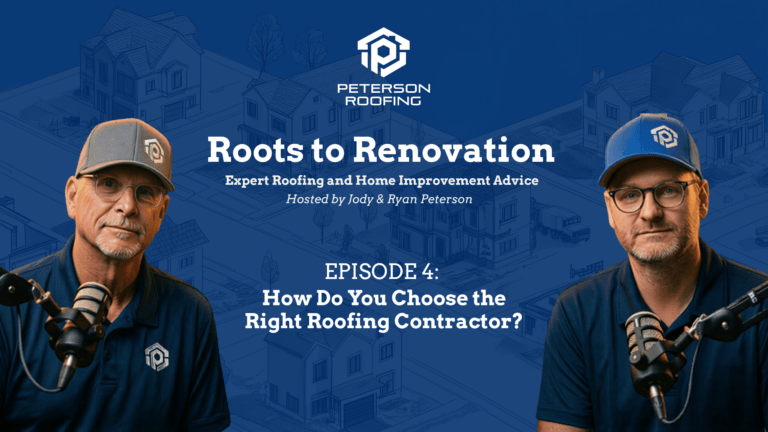
Choosing a roofing contractor is one of the most important decisions a homeowner can make. Your roof protects your home, your family, and your investment, so hiring the right company matters. In a recent discussion on Roots to Renovation, Jody and Ryan Peterson of Peterson Roofing shared valuable advice for homeowners on what to look for when hiring a contractor and how to avoid costly mistakes.
If you are searching for guidance on how to choose a roofing company Davenport Iowa, understanding the warning signs and knowing what questions to ask can help you make a confident decision.
Look for Longevity and Stability
One of the first things homeowners should consider is how long the roofing company has been operating in the local area. A contractor with decades of experience has likely built a strong reputation and proven their reliability over time.
Companies that frequently change names or reorganize can sometimes be trying to escape a poor reputation. Local, established contractors are more likely to stand behind their work because their reputation in the community matters.
Choose a Local Contractor
Hiring a local roofing company provides peace of mind. Storm chasers and out-of-state contractors may appear after severe weather, complete jobs quickly, and then disappear when problems arise.
A local contractor is easier to contact if issues come up after the project is complete. They are also more familiar with local building codes, permit requirements, and weather conditions.
One useful tip mentioned in the discussion was to check license plates and ask where the company’s main office is located. If the business is based far away, that may be a red flag.
Verify Licensing, Bonding, and Insurance
Before signing a contract, homeowners should confirm that the roofing company is properly licensed and insured. In Iowa, contractors are required to hold state and local licensing depending on the municipality.
Proper insurance protects both the homeowner and the contractor if accidents or damage occur during the project. While uninsured contractors may offer lower prices, the financial risk can be significant if something goes wrong.
Ask for References and Past Projects
Homeowners should always ask for local references and examples of older roofing projects. A roof installed last week may look great, but the true test is how it performs over time.
You can also contact local suppliers or building inspectors to learn more about a contractor’s reputation and reliability.
Understand Manufacturer Certifications
Manufacturer certifications can provide additional confidence when selecting a contractor. Certified contractors often have access to extended warranties and specialized training.
For example, Peterson Roofing discussed their certification with Owens Corning, which allows homeowners to receive enhanced warranty protection on labor and materials.
These certifications demonstrate that the contractor meets certain quality and installation standards.
Compare More Than Just Price
The lowest estimate is not always the best value. Homeowners should review whether the estimate is detailed, thorough, and clearly explains the scope of work.
A quality contractor should answer questions openly and identify potential issues before work begins. During the discussion, Ryan Peterson shared an example where solar panels were installed over failing skylights, creating a much larger and more expensive problem later.
An experienced contractor looks at the entire roofing system and helps homeowners avoid future complications.
Watch for Communication and Sales Tactics
Communication before the project often reflects how the contractor will handle the entire job. If a contractor is difficult to reach, unclear in their explanations, or overly aggressive during the sales process, homeowners should proceed carefully.
Pushy sales tactics, pressure to sign immediately, or sudden “limited-time” discounts can all be warning signs.
A trustworthy contractor focuses on educating the homeowner and completing the job correctly rather than rushing the sale.
Written Warranties Matter
Homeowners should always request written warranties for both materials and workmanship. Written documentation clearly explains what is covered and how long the protection lasts.
However, a warranty is only valuable if the contractor remains available to honor it. This is another reason why choosing a stable local company is so important.
Why Family-Owned Roofing Companies Stand Out
Family-owned roofing companies often provide a more personal level of service. Because they live and work in the same community, they are directly accountable to their customers.
Jody and Ryan Peterson emphasized the importance of honesty and transparency, even if that means telling a homeowner they do not need a new roof.
That kind of long-term trust is difficult to find with contractors who are only focused on making quick sales.
Finding the right roofing contractor takes research, patience, and careful evaluation. Homeowners who focus on reputation, communication, experience, and accountability are more likely to have a successful roofing project and long-lasting results.
If you are researching how to choose a roofing company Davenport Iowa, taking the time to compare contractors carefully can save you money, stress, and future repair issues.
FAQs
Why is hiring a local roofing contractor important?
Local contractors are easier to contact after the project is complete and are more likely to stand behind their work. They also understand local building codes and weather conditions.
What should I verify before hiring a roofing contractor?
You should confirm the contractor’s licensing, insurance, bonding, references, and manufacturer certifications.
Are cheaper roofing estimates always better?
Not necessarily. Lower estimates may leave out important work, use lower-quality materials, or come from uninsured contractors.
What are storm chasers in roofing?
Storm chasers are contractors who travel into areas after storms, complete work quickly, and often disappear before warranty issues or repairs arise.
Why do manufacturer certifications matter?
Manufacturer certifications indicate that the contractor meets installation standards and may offer extended warranty options.
What are signs of a trustworthy roofing company?
Clear communication, detailed estimates, local references, honest recommendations, and long-term community involvement are all strong signs of a reliable contractor.
MIKE DOWNER: Hi everybody, I’m your host, Mike Downer, on Roots to Renovation with Peterson Roofing. I am here today with Jody Peterson, founder and CEO, as well as his son Ryan Peterson, COO of Peterson Roofing. How are we doing today, guys?
JODY PETERSON: Doing great. Thanks, Mike.
RYAN PETERSON: Doing great.
MIKE DOWNER: Good deal. So today, I know what we’re talking about—hopefully you guys do too. We’re talking about how to choose the right roofing contractor. I don’t care who takes which question; you guys can just go back and forth.
The core question I have is: what should a homeowner look for, ask, and verify when selecting a roofing contractor, and how do they tell the great ones from the risky ones?
JODY PETERSON: I’ll start, Ryan, and you can chime in. Number one, they should look for longevity. How long has the company been in business in their area? We’ve been around in the Davenport–Bettendorf Quad Cities area for forty-five years under the same name.
That’s important because some companies reorganize every few years—they wear out their welcome and change names. We’ve stayed consistent, and that says a lot.
Risky contractors are often people who just jump into business. Maybe they worked for a bigger company and think, “I can do this myself.” They lack financial stability and real installation expertise. They might be good at sales, but the most important thing is doing the job right after the sale.
Ryan and I have both done the work ourselves—we’re not just salespeople.
RYAN PETERSON: I’ll share a quick story. A friend of mine had storm damage and hired a large regional chain. Years went by, and they still hadn’t replaced his gutters. They had done the roof, but there was confusion—even billing issues.
Eventually, years later, they came back wanting to finish the job but charge more. That wouldn’t happen with us. When you work with us, you deal directly with the owners. You don’t get lost in a big system.
People appreciate knowing who they’re dealing with and that we’ll be here after the job is done.
MIKE DOWNER: That’s definitely peace of mind. So when picking a contractor, what should homeowners know about licensing requirements in Iowa, and what should they verify before signing any contract?
JODY PETERSON: In Iowa, you need to be licensed with the state and the local municipality where you’re working. That usually requires bonding and proper insurance.
Some smaller contractors skip this—they’re cheaper because they don’t have overhead. But if something goes wrong, you won’t be able to reach them.
You might save money upfront, but you’ll pay for it later.
MIKE DOWNER: You get what you pay for, right?
JODY PETERSON: Exactly.
MIKE DOWNER: Why does hiring a local contractor with decades of experience matter compared to working with a storm chaser?
RYAN PETERSON: We see this a lot. Storm chasers come in, do the work, and then disappear. Homeowners later notice leaks or damage and can’t reach anyone.
Now they have to hire someone else to fix it, which costs more in the long run. That could’ve been avoided by choosing a local company from the start.
JODY PETERSON: I actually have an appointment today for that exact situation. A storm chaser did the work, and the homeowner hasn’t heard from them since 2022.
Storm chasers move on to the next town. We stay here, and our reputation is on the line.
MIKE DOWNER: That makes sense. What questions should homeowners ask when checking references, and what answers are red flags?
JODY PETERSON: First, ask where their main office is. Some companies have one main office and many satellite locations. Do you want to deal with someone far away?
With us, you get direct contact—we’ll return your calls quickly.
Also, look at license plates. If they’re from out of state, that’s a red flag.
Ask for local references, especially older projects. A job done last week might look fine, but you need to see how it holds up over time.
You can also call suppliers or local building inspectors for insight.
RYAN PETERSON: Some companies have even lost the ability to get permits because of how they operate—that’s a major red flag.
MIKE DOWNER: Let’s switch gears. What do manufacturer certifications mean, and why do they matter?
JODY PETERSON: We’re certified by Owens Corning. That allows homeowners to get extended warranties—up to fifty years for labor and materials.
We recently replaced a roof we installed seventeen years ago due to discoloration. Owens Corning covered the material, and we handled the labor.
That’s why certification matters—you get real support when issues arise.
MIKE DOWNER: When reviewing estimates, what should homeowners compare beyond price?
JODY PETERSON: First, is the estimate thorough? Many salespeople don’t truly understand roofing—they just measure and sell.
RYAN PETERSON: I saw a case where solar panels were installed on a roof with failing skylights. The roof should’ve been fixed first.
Now the homeowner has a major issue because the skylights need replacing, and the solar panels must be removed first.
A good contractor would’ve explained everything upfront.
So ask: Is the estimate thorough? Were all your questions answered? Can they complete the job properly and on time?
MIKE DOWNER: How can a contractor’s communication style before the job starts indicate how they’ll handle the project?
RYAN PETERSON: If they can’t clearly explain the work, that’s a problem.
Also, watch out for pushy sales tactics—trying to rush you into signing or offering sudden discounts. That’s a red flag.
A good contractor focuses on doing the job right, not just closing the sale.
MIKE DOWNER: What’s the difference between written warranties and verbal promises, and what actually protects the homeowner?
JODY PETERSON: Written warranties from manufacturers are very important. They show what’s covered and for how long.
But even a written guarantee is only as good as the person behind it. Someone unreliable can promise anything and disappear.
That’s why both a solid warranty and a trustworthy contractor matter.
MIKE DOWNER: Finally, what sets Peterson Roofing apart in terms of being family-owned, no-pressure, and offering honest pricing?
RYAN PETERSON: We live in this community and treat customers the way we want to be treated.
Sometimes that means telling people they don’t need a new roof. That honesty builds trust.
JODY PETERSON: We’re accountable because we live here. We see our customers every day.
Storm chasers don’t care—they move on. We’ve been here forty-five years and plan to stay.
MIKE DOWNER: That’s great insight. Thanks again for joining me on Roots to Renovation. We’ll see you next time.
JODY PETERSON: Thank you.
RYAN PETERSON: Thanks, Mike.