When it comes to protecting a home in Iowa and answering the question of what roofing material is best for Quad Cities weather, few decisions are more important than selecting the right roofing material. Between harsh winters, strong summer storms, hail, high winds, and dramatic temperature swings, roofs in the Midwest face challenges that homeowners in many other parts of the country never experience.
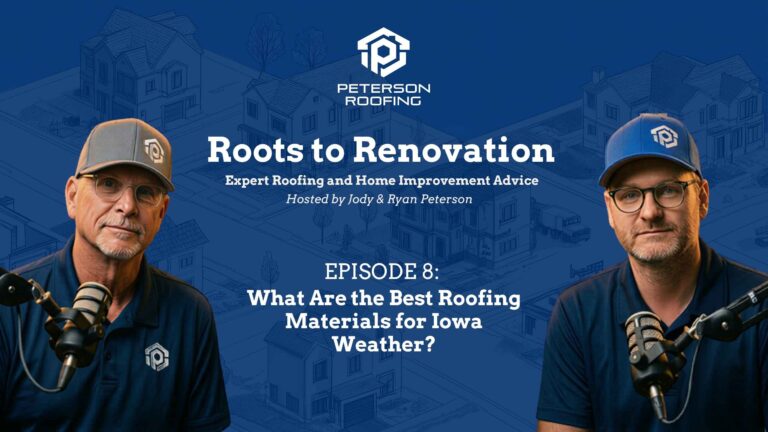
In an episode of Roots to Renovation, host Mike Downer sat down with Jody Peterson, Founder and CEO of Peterson Roofing, and Ryan Peterson, COO of Peterson Roofing, to discuss the roofing materials that consistently perform best in the Quad Cities region. Drawing from more than 45 years of roofing experience, the Peterson team shared valuable insights into shingles, metal roofing, ventilation, underlayment, and long-term roof performance.
Why Architectural Shingles Dominate Iowa Roofing
One of the biggest shifts in residential roofing over the last few decades has been the move away from traditional three-tab shingles and toward architectural shingles.
According to Ryan Peterson, architectural shingles offer a significant upgrade in design and durability. Unlike three-tab shingles, which have thinner sections between tabs, architectural shingles use a laminated construction that creates a thicker, stronger product.
This added thickness helps the roof withstand Iowa’s weather conditions more effectively. Architectural shingles also provide a more dimensional appearance, giving homes improved curb appeal while delivering better performance.
Today, architectural shingles have become the standard roofing choice across Iowa and much of the Midwest.
Why Peterson Roofing Recommends Owens Corning
Not all shingles are created equal.
When discussing preferred manufacturers, Jody Peterson emphasized that Peterson Roofing evaluates products based on real-world performance rather than marketing claims.
“We’ve used Owens Corning shingles for many years because we rarely have issues with them,” Jody explained.
Over decades of installations, Peterson Roofing has experienced very few warranty claims or product failures with Owens Corning products. While competing manufacturers have improved over the years, Peterson Roofing continues to recommend Owens Corning Duration shingles because of their reliability, durability, and consistent long-term performance.
For homeowners, fewer callbacks and fewer product issues translate into greater peace of mind.
Are Class IV Impact-Resistant Shingles Worth It?
As severe weather events become more common throughout Iowa, many homeowners are considering impact-resistant roofing options.
Most standard architectural shingles carry a Class III impact rating, which offers protection against smaller hail events. Class IV shingles provide a higher level of impact resistance and are specifically designed to withstand larger hailstones.
Ryan Peterson noted that while Class IV shingles do cost more upfront, they may help homeowners avoid significant expenses in the future, especially as insurance deductibles continue to increase.
The insurance savings alone may not completely offset the additional cost of installation, but the added protection can provide valuable long-term benefits in hail-prone areas.
For many Iowa homeowners, investing in impact-resistant roofing can be a practical way to reduce future storm-related damage.
The Pros and Cons of Metal Roofing
Metal roofing continues to grow in popularity, but it isn’t necessarily the perfect solution for every home.
One of the biggest advantages of metal roofing is longevity. Metal roofs typically last much longer than traditional asphalt shingles and perform well during hail and wind events.
However, there are tradeoffs.
The most obvious drawback is cost. Metal roofing systems can be significantly more expensive than architectural shingles.
Ryan Peterson also pointed out that while metal roofs resist many forms of damage, hail can still leave dents. Increasingly, insurance carriers classify these dents as cosmetic damage, meaning replacement may not be covered.
Noise can also be a consideration. Depending on the home’s construction and insulation, some homeowners notice increased sound during heavy rainstorms.
Aesthetics matter as well. As Jody Peterson explained, a standing-seam metal roof can sometimes look out of place in neighborhoods dominated by traditional shingle roofs, potentially affecting resale appeal.
When Premium Designer Shingles Make Sense
For homeowners looking to elevate curb appeal, designer shingles offer a premium option.
These products are designed to create distinctive visual effects through enhanced color variation, texture, and dimensional appearance. They can mimic high-end materials while maintaining the advantages of asphalt roofing.
Ryan Peterson stressed that designer shingles work best when they complement the home’s overall exterior design.
A beautiful roof should enhance the home’s architecture rather than compete with it. Choosing the right style and color combination is essential for achieving the desired aesthetic result.
Why Underlayment Matters More Than Most Homeowners Realize
Many homeowners focus entirely on the shingles they can see, but the materials underneath are equally important.
Roofing underlayment serves as a secondary barrier against water intrusion. If severe weather damages shingles or blows them off entirely, the underlayment provides temporary protection until repairs can be completed.
Jody Peterson described underlayment as a critical backup system that helps prevent water from entering the home during storm events.
A quality roofing system isn’t just about the outer layer. Every component works together to protect the structure.
Proper Ventilation Can Extend Roof Life
One of the most overlooked aspects of roofing performance is attic ventilation.
Without proper airflow, attic temperatures can rise dramatically during summer months. Excessive heat can accelerate shingle aging and shorten roof lifespan.
Ventilation also plays a major role during winter by reducing condensation and moisture accumulation.
Ryan Peterson shared an example of a home where a kitchen exhaust vent terminated inside the attic instead of venting outdoors. Over time, moisture buildup caused significant wood rot and structural damage.
Proper intake and exhaust ventilation help prevent these issues while ensuring roofing warranties remain valid.
Does Roof Color Affect Energy Efficiency?
Roof color does influence heat absorption.
Darker shingles absorb more solar heat, which can increase attic temperatures. However, Jody Peterson emphasized that proper insulation and ventilation are far more important than color selection alone.
Modern roofing products are engineered to handle heat far better than older generations of shingles. As a result, homeowners can usually prioritize appearance without worrying about significant impacts on indoor comfort.
If you’ve been asking yourself what roofing material is best for Quad Cities weather, the Peterson Roofing team makes a compelling case for high-quality architectural shingles backed by proven installation practices and decades of local experience.
Frequently Asked Questions
What type of roofing lasts longest in Iowa?
Metal roofing generally offers the longest lifespan, often lasting 40 to 70 years. However, high-quality architectural shingles can also provide decades of reliable performance when properly installed.
Are architectural shingles better than three-tab shingles?
Yes. Architectural shingles are thicker, stronger, more durable, and typically offer better wind resistance and curb appeal.
What are Class IV shingles?
Class IV shingles are impact-resistant roofing products designed to withstand larger hail impacts and reduce storm-related damage.
Do impact-resistant shingles lower insurance premiums?
Some insurance companies offer discounts, but savings vary by carrier and location.
Is metal roofing worth the extra cost?
For homeowners prioritizing longevity and durability, metal roofing can be a worthwhile investment. However, the higher upfront cost should be carefully considered.
Why is roof ventilation important?
Proper ventilation helps regulate attic temperature, reduces moisture buildup, extends roof lifespan, and supports warranty compliance.
Does roof color affect cooling costs?
Darker roofs absorb more heat, but proper insulation and ventilation have a much greater impact on energy efficiency.
What roofing material does Peterson Roofing recommend most?
Peterson Roofing most frequently recommends Owens Corning Duration architectural shingles because of their long-term durability, reliability, and overall value.
Mike Downer: Hi everybody, I’m your host, Mike Downer. Welcome to Roots to Renovation. I am here with Jody Peterson and Ryan Peterson, the Founder/CEO and COO of Peterson Roofing in the Quad Cities. How are we doing today, fellas?
Jody Peterson: Doing great, Mike.
Ryan Peterson: Doing great. Good to see you again.
Mike Downer: It’s great to see you guys. We’re going to learn a little more about roofs and what we should do with them. Today, what I wanted to talk about is the best roofing materials for Iowa weather. That’s a big question because different climates, houses, and regions of the United States use different roofing materials. So, which roofing materials perform best in Iowa’s climate with harsh winters, summer storms, hail, and massive temperature swings?
Jody Peterson: That’s a good question. Here at Peterson Roofing, we’ve been doing this for 45 years in the Davenport–Quad Cities area. We’ve installed pretty much every type of roof you can imagine in this region, and over the years we’ve seen which ones hold up best. Choosing the right one is what we’re going to discuss today.
Mike Downer: Why have architectural asphalt shingles become the most popular roofing choice in the Quad Cities and Iowa? And what separates the best brands from the rest?
Ryan Peterson: Architectural shingles have been around for quite a while, and slowly but surely they’ve taken over. The common shingles we used to see were called three-tab shingles. They looked like rows of little rectangles and were probably designed to mimic slate tile. They had been around for decades and did the job.
Then a better shingle came along—the architectural or laminate-style shingle. It’s still made from essentially the same materials, but it’s a much better design. A three-tab shingle has thin areas between the tabs, which are often the weakest points. A laminate-style shingle has a full base layer with additional layers laminated on top, creating a much thicker and stronger product. Today, it’s by far the most popular roofing choice in this part of the country.
Mike Downer: What separates the best brands from all the others?
Jody Peterson: For us, it comes down to callbacks. We’ve used Owens Corning shingles for many years because we rarely have issues with them. I think we’ve only had three claims in twenty years of using those shingles.
Other manufacturers have improved because they have to stay competitive, but we judge products by how often customers call us with problems like shingles blowing off, discoloration, curling, or deterioration. We just don’t see much of that with Owens Corning.
Mike Downer: Are impact-resistant Class IV shingles worth the investment for Iowa homeowners? Can they really help lower insurance premiums?
Ryan Peterson: Iowa has become a major storm state with frequent hail events. Most architectural shingles today are Class III rated, which means they can handle small hail fairly well. Class IV shingles are designed for larger hail impacts, which we’re seeing more often.
They do cost more, and whether they’re worth it depends on your situation. Insurance deductibles are changing. We’re seeing more percentage-based deductibles instead of fixed deductibles. Spending a little more on a Class IV shingle may help you avoid a much larger out-of-pocket expense later.
Mike Downer: Have you seen cases where they lower insurance premiums?
Jody Peterson: Some homeowners report savings, but generally the savings don’t fully offset the additional cost of the shingles. However, I can see insurance companies moving more in that direction as they encourage homeowners to install impact-resistant products.
Mike Downer: What are the biggest pros and cons of metal roofing for Iowa homes, including durability, ice shedding, noise levels, and cost?
Ryan Peterson: There are several types of metal roofing. Some metal shingles are designed to resemble traditional roofing materials, while standing-seam metal roofs are the style most people think of when they hear “metal roof.”
The biggest drawback is cost. Metal roofs are significantly more expensive than asphalt shingles. However, they perform well against hail, although they can dent. Insurance companies increasingly classify those dents as cosmetic damage and may not cover replacement.
Metal roofs can also be noisier during rainstorms, depending on insulation and construction. I even had one customer say that after installing a metal roof, his cell phone reception became worse inside the house.
Jody Peterson: Another consideration is appearance. If every home in the neighborhood has architectural shingles and you install a standing-seam metal roof, it may look out of place. That can affect resale appeal, even if you personally love the look.
Mike Downer: When does it make sense to invest in premium designer shingles?
Ryan Peterson: Designer shingles are all about aesthetics. Owens Corning offers a variety of colors and styles. These shingles often have more variation in color and texture, making the roof a visual focal point.
They can look fantastic on the right home, but if your exterior already has a lot going on—such as highly variegated brick—the roof and exterior can sometimes clash. It’s important to choose a style that complements the overall appearance of the home.
Mike Downer: How important is underlayment in a roofing system, and why should homeowners care about what’s underneath the shingles?
Jody Peterson: Underlayment is very important. If severe weather causes shingles to blow off, the underlayment acts as a backup layer of protection. It helps keep water out of your home until repairs can be made. While it’s not more important than the shingles themselves, it’s a critical secondary defense.
Mike Downer: How does proper attic ventilation affect the lifespan and performance of a roof?
Ryan Peterson: Proper ventilation is essential. Without it, attic temperatures can become extremely high, causing shingles to age prematurely. Manufacturers require a certain amount of intake and exhaust ventilation, and if you don’t meet those requirements, warranty coverage may be affected.
Good ventilation also helps prevent condensation problems during the winter. At Peterson Roofing, we make sure ventilation systems are designed and functioning properly.
Mike Downer: You mentioned an example earlier involving improper venting.
Ryan Peterson: Yes. I recently inspected a home where a kitchen exhaust vent terminated inside the attic instead of venting outdoors. Over many years, warm, moist air condensed on the underside of the roof deck and caused severe rot. Proper venting is critical to prevent moisture damage like that.
Mike Downer: Does shingle color affect energy efficiency and attic temperatures?
Jody Peterson: Yes, darker shingles absorb more heat, which can increase attic temperatures. However, if the attic is properly insulated and ventilated, that heat shouldn’t significantly affect the living space below.
Modern shingles are also built differently than they were decades ago. They resist heat-related deterioration much better than older products did. So homeowners should choose the color they like and focus on making sure the home is properly insulated and ventilated.
Mike Downer: Based on 45 years of experience in the Quad Cities, what roofing materials does Peterson Roofing recommend most often?
Ryan Peterson: Owens Corning Duration shingles remain our top recommendation. We’ve used them for years and had excellent results. They provide a strong combination of durability, performance, and value. We trust them because we’ve seen how they perform over time.
Jody Peterson: Owens Corning doesn’t pay us to recommend their products. We recommend them because they give homeowners peace of mind and because we’ve had great experiences with them over the years.
Mike Downer: As we always say, you run into customers at grocery stores, restaurants, and gas stations. You want to be proud of the work you’ve done and not hide from people.
Thank you both for joining me today. We learned a lot about roofing materials, what works best in Iowa, and why these choices matter. Next time, we’ll talk about roof inspections.
Ryan Peterson: Sounds good.
Jody Peterson: Thanks, Mike.
Mike Downer: Thanks for joining me today, guys. Take care.